AI-Powered Fact-Checking: Revolutionizing Misinformation Combat by 2026
In an era defined by rapid information dissemination, the battle against misinformation has become more critical than ever. False narratives, disinformation campaigns, and misleading content spread like wildfire, eroding public trust and impacting everything from public health to democratic processes. However, a powerful ally is emerging from the realm of technology: AI-powered fact-checking tools. These innovative solutions are poised to revolutionize how we verify information, with ambitious predictions suggesting a significant reduction in misinformation in the U.S. by 2026. This comprehensive exploration delves into the transformative potential of AI fact-checking tools, examining their mechanisms, challenges, and the profound impact they are expected to have on our information landscape.
The proliferation of misinformation is not a new phenomenon, but the digital age has amplified its reach and speed. Social media platforms, instant messaging apps, and an always-on news cycle create fertile ground for misleading content to thrive. Traditional fact-checking methods, while essential, often struggle to keep pace with the sheer volume of information. This is where artificial intelligence steps in, offering capabilities that can analyze, cross-reference, and flag suspicious content at an unprecedented scale and speed. The promise of AI-powered fact-checking tools is not just about identifying falsehoods; it’s about building a more resilient information ecosystem.
The Urgent Need for AI Fact-Checking Tools
The statistics surrounding misinformation are stark. Studies consistently show that false news travels faster and wider than true information, particularly on social media. This has tangible consequences, influencing elections, fueling vaccine hesitancy, and even inciting violence. The human brain is naturally susceptible to cognitive biases, making us vulnerable to narratives that confirm our existing beliefs, regardless of their veracity. This vulnerability is expertly exploited by those who intentionally spread disinformation.
Moreover, the rise of sophisticated propaganda techniques, including deepfakes and AI-generated text, further complicates the landscape. These advanced methods make it increasingly difficult for the average person to distinguish between genuine and fabricated content. The sheer volume of content produced daily makes it impossible for human fact-checkers alone to vet everything. This creates an urgent and undeniable need for scalable, efficient, and intelligent solutions – a role perfectly suited for AI fact-checking tools.
How AI Fact-Checking Tools Work: A Deep Dive into Technology
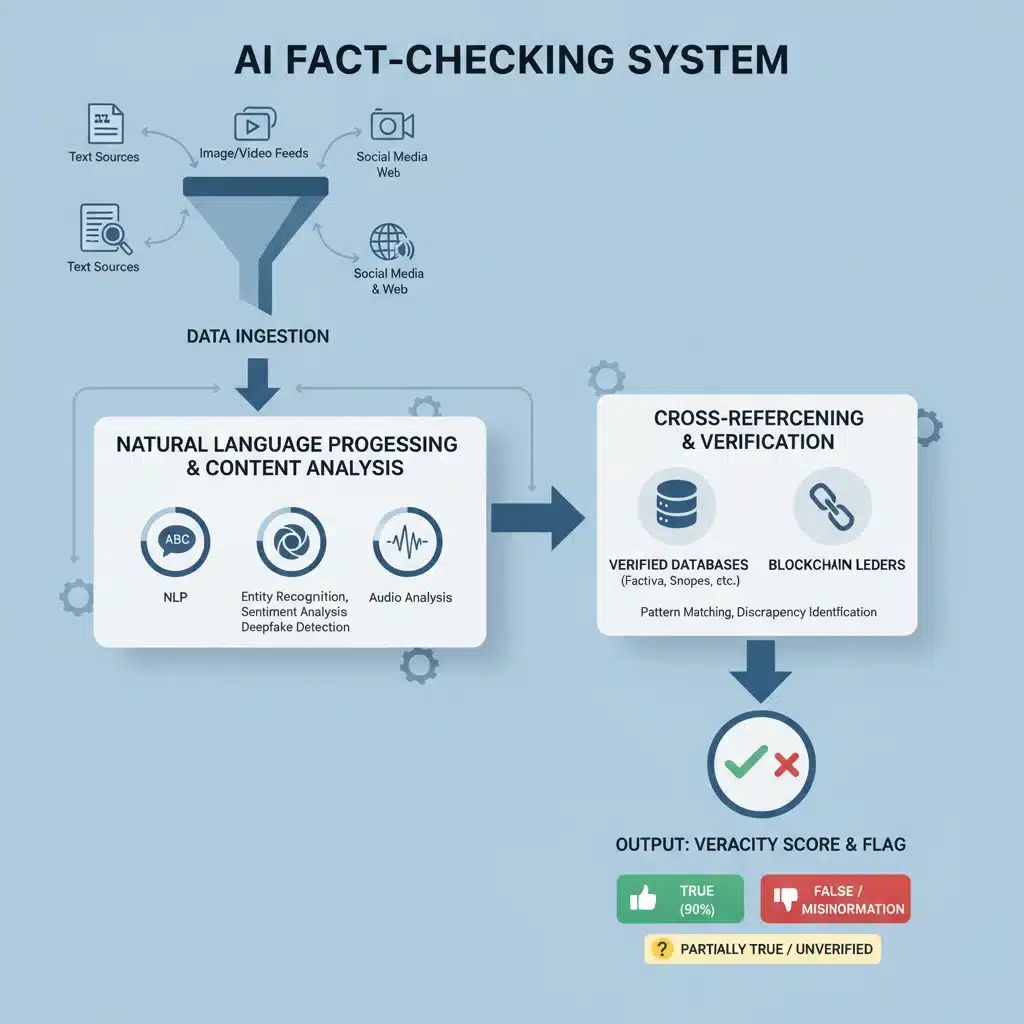
At its core, AI fact-checking involves leveraging various artificial intelligence and machine learning techniques to automate and assist in the verification process. These tools are designed to analyze vast amounts of data, identify patterns, and assess the credibility of information. Here’s a breakdown of the key technologies involved:
Natural Language Processing (NLP)
NLP is fundamental to how AI fact-checking tools understand and interpret textual content. It allows AI to:
- Extract Key Information: Identify the main claims, entities (people, organizations, places), and events mentioned in a piece of content.
- Sentiment Analysis: Determine the emotional tone of the text, which can sometimes indicate manipulative intent.
- Stance Detection: Analyze whether a piece of content supports or refutes a particular claim.
- Semantic Understanding: Go beyond keywords to grasp the meaning and context of sentences and paragraphs, crucial for identifying subtle forms of misinformation.
Computer Vision and Image/Video Analysis
Misinformation isn’t limited to text. Images and videos are powerful mediums for spreading false narratives. AI fact-checking tools use computer vision to:
- Detect Image Manipulation: Identify signs of tampering, such as image stitching, object removal, or alteration, using forensic techniques.
- Reverse Image Search: Trace the origin of an image or video to determine if it has been used out of context or is older than claimed.
- Deepfake Detection: Employ advanced algorithms to identify subtle anomalies in facial movements, speech patterns, and lighting that indicate AI-generated or manipulated video content. This is a rapidly evolving field, with AI models constantly being trained on new deepfake techniques.
Data Mining and Cross-Referencing
A significant part of fact-checking involves comparing claims against a vast repository of known facts and credible sources. AI excels at this:
- Accessing Knowledge Bases: Connecting to extensive databases of verified facts, academic research, official reports, and reputable news archives.
- Source Credibility Assessment: Evaluating the trustworthiness of sources by analyzing their publication history, editorial standards, and past accuracy.
- Pattern Recognition: Identifying recurring false claims or narratives that have been debunked previously. This allows for rapid identification of old misinformation repackaged as new.
Machine Learning and Deep Learning
These are the engines that power the intelligence of AI fact-checking tools. Machine learning models are trained on massive datasets of both true and false information, learning to identify characteristics associated with each. Deep learning, a subset of machine learning, uses neural networks to perform more complex tasks:
- Classification: Categorizing content as true, false, misleading, or opinion.
- Anomaly Detection: Flagging content that deviates significantly from established facts or patterns.
- Predictive Analysis: Identifying emerging misinformation trends and potential vectors for their spread.
The Expected Impact: A 20% Reduction by 2026 in the U.S.
The prediction of a 20% reduction in misinformation in the U.S. by 2026, driven by AI fact-checking tools, is an ambitious yet achievable goal. This reduction is not merely about identifying individual false claims but about creating a systemic shift in how information is consumed and verified. Several factors contribute to this optimistic outlook:
Enhanced Speed and Scale
AI can process information at a speed and scale that is impossible for human fact-checkers. This means that false narratives can be identified and flagged much earlier in their lifecycle, before they gain significant traction. The ability to scan millions of articles, social media posts, and videos daily is a game-changer.
Proactive Identification
Instead of reacting to misinformation after it has spread, AI fact-checking tools are increasingly capable of proactive identification. By monitoring trending topics and analyzing early indicators, AI can predict where misinformation might emerge and alert relevant parties, enabling preemptive measures.
Integration with Platforms
The most significant impact will come from the seamless integration of these tools into social media platforms, search engines, and news aggregators. When a user encounters potentially misleading content, AI can instantly provide context, links to verified sources, or even flag the content as unverified. This immediate feedback loop is crucial for user education and behavior modification.
Improved Media Literacy
Exposure to AI-powered fact-checking can subtly but effectively improve media literacy among the general public. When users consistently see flags or contextual information on dubious content, they become more adept at critical thinking and questioning sources, even without direct AI intervention. This fosters a more discerning audience over time.
Support for Human Fact-Checkers
AI is not designed to replace human fact-checkers but to augment their capabilities. By handling the initial sifting and flagging of content, AI frees up human experts to focus on complex cases, nuanced interpretations, and investigative journalism. This collaborative approach maximizes efficiency and accuracy.
Challenges and Ethical Considerations for AI Fact-Checking Tools
While the potential benefits are immense, the deployment of AI fact-checking tools is not without its challenges and ethical considerations. Addressing these is crucial for their effective and responsible implementation.
Bias in AI Models
AI models are only as unbiased as the data they are trained on. If training data contains inherent biases, the AI might inadvertently perpetuate or even amplify them. This could lead to certain viewpoints being unfairly flagged as misinformation or genuine content being overlooked. Ensuring diverse, representative, and carefully curated training datasets is paramount.
The "Black Box" Problem
Many advanced AI models, especially deep learning networks, operate as "black boxes," meaning their decision-making processes are not easily interpretable by humans. This lack of transparency can be problematic when fact-checking, as users and content creators may demand to know why a piece of content was flagged. Developing explainable AI (XAI) that can articulate its reasoning is an significant area of research.
Evolving Misinformation Tactics
The creators of misinformation are constantly evolving their tactics. AI models must continuously adapt and learn to keep pace with new forms of deception, including increasingly sophisticated deepfakes, subtle narrative manipulation, and the use of seemingly innocuous content to spread harmful ideas. This requires ongoing research, development, and model retraining.
Freedom of Speech Concerns
The power of AI to flag and potentially limit the spread of content raises legitimate concerns about freedom of speech and censorship. Striking the right balance between combating harmful misinformation and protecting legitimate expression is a delicate act. Clear guidelines, transparent appeals processes, and human oversight are essential to prevent overreach.
Context and Nuance
Fact-checking is often about more than just identifying a factual error; it involves understanding context, intent, and nuance. Sarcasm, satire, opinion pieces, and artistic expressions can be easily misinterpreted by AI. Developing AI that can grasp these subtleties is a significant challenge and highlights the continued need for human judgment.
Data Privacy and Security
To be effective, AI fact-checking tools often need access to vast amounts of public and sometimes private data. Ensuring the privacy and security of this data, and preventing its misuse, is a critical ethical and technical challenge. Robust data governance frameworks are necessary.
Beyond 2026: The Future Landscape of Information
The journey towards a more truthful information environment extends far beyond 2026. The continuous evolution of AI fact-checking tools will shape the future landscape of how we consume, create, and verify information. Here are some anticipated developments:
Hyper-Personalized Fact-Checking
Future AI tools might offer personalized fact-checking feeds and alerts, tailored to an individual’s consumption habits and potential exposure to specific types of misinformation. This could help users build more resilient information diets.
Cross-Lingual and Cross-Cultural Verification
Misinformation is a global problem. AI will increasingly be able to perform cross-lingual fact-checking, breaking down language barriers to verify claims across different cultures and regions, which is crucial for international discourse.
Real-time Verification at the Point of Consumption
Imagine a future where your smart glasses or augmented reality interface can provide real-time veracity checks on information you encounter in the physical world, from product labels to public statements. This seamless integration could fundamentally alter our relationship with information.
Collaborative AI Networks
Instead of isolated tools, we may see networks of AI fact-checking systems collaborating and sharing insights, creating a more robust and adaptive defense against misinformation at a global scale. This distributed intelligence could enhance both speed and accuracy.
Empowering Citizens with AI Tools
The development of user-friendly AI fact-checking tools that are accessible to the general public could empower individuals to become their own first line of defense against misinformation. This democratization of verification capabilities could be a powerful force for media literacy.

The Role of Education and Human Critical Thinking
While AI fact-checking tools are indispensable, they are not a silver bullet. The fight against misinformation also requires a strong emphasis on education and fostering human critical thinking skills. AI can provide the tools, but humans must learn how to use them effectively and develop the discernment to question, analyze, and seek out diverse perspectives.
Educational initiatives that teach media literacy, digital citizenship, and critical thinking from an early age are vital. Understanding how algorithms work, recognizing common propaganda techniques, and being aware of one’s own biases are skills that complement AI tools, creating a more holistic defense against false narratives. The goal is not to outsource our critical thinking entirely to AI, but to empower ourselves with better tools and knowledge.
Conclusion: A Brighter, More Factual Future with AI Fact-Checking Tools
The prospect of reducing misinformation by 20% in the U.S. by 2026, largely thanks to the advancement and deployment of AI-powered fact-checking tools, represents a significant step forward in our digital evolution. These tools offer unprecedented capabilities for speed, scale, and accuracy in identifying and combating false narratives. While challenges related to bias, transparency, and evolving tactics remain, ongoing research and ethical considerations are paving the way for more robust and responsible AI deployment.
The future of information is a collaborative one, where cutting-edge AI fact-checking tools work in tandem with human expertise and an increasingly media-literate public. By embracing these technological advancements while simultaneously investing in education and critical thinking, we can collectively build a more trustworthy and informed society, where truth is more easily found, and misinformation struggles to take root. The journey is complex, but the destination—a more factual and resilient information ecosystem—is well within reach.