Blockchain for News: Combating Misinformation & Building Trust by 2026

In an era characterized by an overwhelming deluge of information, the distinction between fact and fiction has become increasingly blurred. Misinformation and disinformation campaigns pose a significant threat not only to the integrity of democratic processes but also to the very foundation of public trust in news organizations. The United States media landscape, in particular, has seen a precipitous decline in public confidence, making the search for innovative solutions more urgent than ever. As we look towards 2026 and beyond, blockchain technology emerges as a powerful, albeit often misunderstood, tool that could revolutionize how news is produced, disseminated, and consumed, ultimately helping to restore faith in the Fourth Estate.
The core promise of blockchain lies in its ability to create immutable, transparent, and decentralized records. This inherent characteristic makes it exceptionally well-suited to address some of the most pressing challenges faced by modern journalism: verifying content authenticity, preventing tampering, and fostering a verifiable chain of custody for information. This article will delve into the critical role blockchain can play in combating misinformation and propose three practical solutions for US news organizations to significantly enhance trust by 2026. By embracing these technological advancements, news outlets can proactively safeguard their journalistic integrity and provide audiences with the credible information they desperately seek.
The Erosion of Trust: A Pressing Challenge for US News Organizations
Before exploring the solutions, it’s crucial to understand the depth of the crisis facing US news organizations. Public trust in media has been on a downward trajectory for years. A 2023 Gallup poll revealed that only 32% of Americans have a great deal or fair amount of trust in the mass media – a near-record low. This erosion of trust is fueled by several factors, including political polarization, the proliferation of ‘fake news’ on social media, the speed at which false narratives can spread, and a general skepticism about editorial biases.
Misinformation isn’t just annoying; it has real-world consequences, impacting public health decisions, election outcomes, and social cohesion. For news organizations, the challenge is twofold: not only must they report accurately, but they must also demonstrate their accuracy in a way that is transparent and verifiable to an increasingly skeptical audience. Traditional methods of fact-checking, while vital, often struggle to keep pace with the sheer volume and velocity of false information. This is where the decentralized, cryptographic security of blockchain technology offers a compelling new frontier.
Why Blockchain? Understanding its Unique Advantages for Journalism
Blockchain, at its heart, is a distributed ledger technology (DLT) that records transactions in a way that makes them difficult or impossible to change, hack, or cheat. Each ‘block’ in the chain contains a timestamped batch of valid transactions, and once recorded, a transaction cannot be altered without altering all subsequent blocks and the consensus of the majority of the network. This provides several key advantages pertinent to journalism:
- Immutability: Once information is recorded on a blockchain, it becomes virtually impossible to alter or delete. This is paramount for proving the authenticity of news content over time.
- Transparency: All participants in a public blockchain network can see the transactions, though identifying details can be anonymized. This allows for an open and auditable trail of information.
- Decentralization: Unlike traditional databases, there is no central authority controlling a blockchain. This reduces single points of failure and makes the system more resistant to censorship or manipulation.
- Timestamping: Every piece of data added to a blockchain is automatically timestamped, providing irrefutable proof of when a piece of content was created or modified.
- Cryptography: Data on a blockchain is secured using advanced cryptographic techniques, ensuring the integrity and authenticity of the information.
These features position blockchain as a powerful ally in the fight against misinformation, offering a technological infrastructure that can underpin a new era of verifiable and trustworthy journalism. The time for US news organizations to seriously consider and implement these solutions is now, aiming for significant impact by 2026.
Practical Solution 1: Verifiable Content Provenance and Authenticity
One of the most direct applications of blockchain in journalism is establishing clear content provenance and authenticity. Misinformation often thrives when the origin of a piece of information is obscure or when images and videos are manipulated without detection. Blockchain can provide an unalterable record of a news item’s journey from creation to publication, giving audiences confidence in its legitimacy.
How it Works:
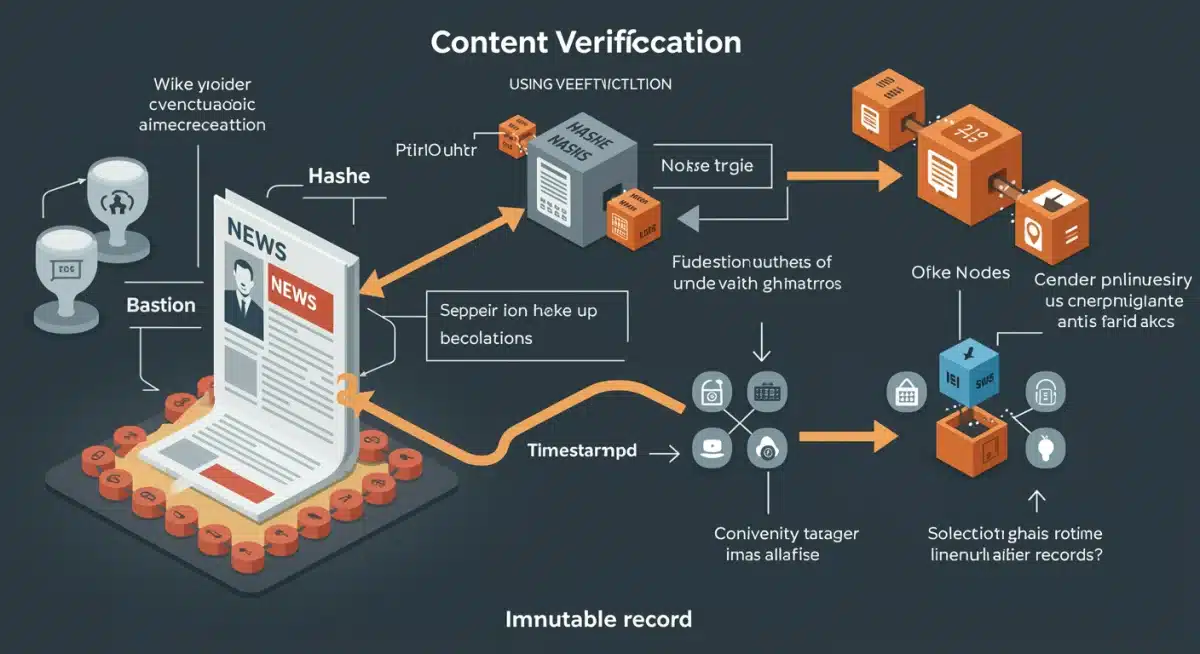
- Content Hashing and Timestamping: When a journalist creates an article, takes a photograph, or records a video, a unique digital fingerprint (hash) of that content can be generated. This hash, along with a timestamp, is then recorded on a blockchain.
- Immutable Record: This blockchain entry serves as an immutable record of when and by whom (or by which organization) the content was created or first published. Any subsequent alteration to the content would result in a different hash, immediately signaling that the original content has been modified.
- Verification Tools: News organizations can develop or integrate tools that allow readers to easily verify the authenticity of any piece of content. By clicking a ‘Verify’ button, readers could see the blockchain record, confirming that the article, image, or video they are viewing matches the original, untampered version.
- Source Attribution: Beyond just the content itself, blockchain can also record the provenance of sources. If a journalist interviews a source, the consent and details (anonymized if necessary) could be cryptographically linked to the story, building a transparent chain of evidence.
Benefits for US News Organizations by 2026:
- Enhanced Credibility: By offering a clear, verifiable chain of custody for their content, news organizations can significantly bolster their credibility and stand apart from sources of unverified or manipulated information.
- Combat Deepfakes and Edited Media: This solution provides a robust defense against deepfakes and other sophisticated media manipulation techniques. If an image or video is altered, its blockchain hash will no longer match the original, immediately flagging it as potentially fraudulent.
- Faster Fact-Checking: Fact-checkers can leverage these blockchain records to quickly ascertain the original source and timestamp of content, streamlining their verification processes.
- Audience Empowerment: Empowering readers with tools to verify content themselves fosters a more engaged and trusting audience, shifting the burden of trust from blind faith to verifiable evidence.
Implementing this solution requires an industry-wide commitment to adopting certain standards and potentially collaborating on shared blockchain infrastructure. Projects like the Content Authenticity Initiative (CAI), though not exclusively blockchain-based, demonstrate a growing recognition of the need for content provenance. Integrating blockchain into such initiatives could provide an even more robust and tamper-proof solution.
Practical Solution 2: Immutable Archives and Transparent Corrections
The historical record of news is critical. However, traditional archives can be vulnerable to tampering, and corrections, while necessary, can sometimes be perceived as attempts to hide or alter past mistakes. Blockchain offers a way to create truly immutable news archives and to manage corrections with unparalleled transparency, further solidifying blockchain news trust.
How it Works:
- Permanent Content Storage: Every published article, broadcast transcript, or significant news report can be hashed and permanently recorded on a blockchain. This creates an unalterable, timestamped record of the content as it was published at a specific moment in time.
- Version Control with Transparency: If a correction or update is needed for an article, the original version remains on the blockchain. The corrected version is then also hashed and added to the blockchain, with a clear link to the original entry and a detailed explanation of the changes made. This creates a transparent audit trail of all revisions.
- Publicly Verifiable History: Readers can access the complete history of an article, seeing its original form, all subsequent corrections, and the reasons for those changes. This eliminates any doubt about whether a news organization is attempting to ‘erase’ or silently alter past reporting.
- Secure Digital Library: This blockchain-powered archive acts as a secure, decentralized digital library, protecting journalistic output from censorship, accidental deletion, or malicious alteration, ensuring the historical record remains intact and accessible.
Benefits for US News Organizations by 2026:
- Enhanced Accountability: News organizations can demonstrate a higher level of accountability by openly displaying all changes and corrections, fostering greater public trust.
- Preservation of Journalistic Record: Ensures the long-term preservation of journalistic output in its original and revised forms, critical for historical accuracy and research.
- Reduced Accusations of Bias/Cover-up: By making the correction process fully transparent, news organizations can mitigate accusations of bias or attempts to cover up errors, strengthening their reputation for integrity.
- Legal and Ethical Protection: An immutable record of published content can serve as strong evidence in cases of libel, copyright infringement, or other legal disputes, protecting both the news organization and the journalists.
The implementation of immutable archives and transparent corrections can be achieved through specific blockchain protocols designed for data storage and versioning. This approach not only protects the integrity of the news itself but also reinforces the ethical commitment of news organizations to accuracy and transparency, vital for building blockchain news trust.
Practical Solution 3: Decentralized Fact-Checking and Reputation Systems
While internal fact-checking is essential, the scale of misinformation often overwhelms individual newsrooms. Blockchain can facilitate decentralized fact-checking networks and build reputation systems for journalists and sources, distributing the burden and enhancing collective verification efforts.
How it Works:
- Collaborative Fact-Checking Networks: News organizations could join a blockchain-based consortium where fact-checkers from different outlets can collaboratively verify claims. When a claim is fact-checked, the findings and supporting evidence are hashed and recorded on the blockchain, with multiple fact-checkers signing off on the verification.
- Reputation Scores for Sources and Journalists: Based on the accuracy and verifiable provenance of their past reporting, journalists and even anonymous sources (through pseudonymous identifiers) could accumulate reputation scores on the blockchain. These scores would be transparent and immutable, reflecting their history of truthful contributions.
- Incentivized Verification: Blockchain-based reward mechanisms (e.g., small cryptocurrency tokens) could incentivize community members or independent experts to participate in fact-checking or to provide verifiable evidence related to news stories.
- Crowdsourced Verification of User-Generated Content: For user-generated content (UGC) often shared on social media, blockchain could enable a decentralized verification process. Users could submit content for verification, and a network of validators could assess its authenticity, with their findings recorded on the blockchain.

Benefits for US News Organizations by 2026:
- Faster and Broader Fact-Checking: Decentralized networks can mobilize more resources and expertise, allowing for quicker and more comprehensive fact-checking of a wider range of information.
- Credibility for Journalists and Sources: A verifiable on-chain reputation score can distinguish credible journalists and sources from unreliable ones, giving audiences a clear indicator of trustworthiness. This is crucial for building blockchain news trust.
- Community Engagement: Incentivizing public participation in verification efforts can foster a more informed and engaged citizenry, turning passive consumers into active participants in the fight against misinformation.
- Reduced Burden on Individual Newsrooms: By distributing the workload, this approach alleviates some of the immense pressure on individual news organizations to fact-check every piece of potentially false information.
This solution leverages the decentralized nature of blockchain to create a more resilient and distributed system for verifying information. It would require significant collaboration among news organizations, perhaps through a non-profit foundation or industry consortium, to establish the protocols and governance for such a system.
Challenges and Considerations for Implementation by 2026
While the potential of blockchain in combating misinformation and building trust is immense, its implementation is not without challenges. US news organizations, and the broader media ecosystem, must address several key considerations:
- Scalability and Cost: Public blockchains can be slow and expensive for storing large volumes of data. Solutions might involve using ‘layer 2’ scaling solutions or leveraging hybrid approaches where only hashes are stored on a public blockchain, with the actual content residing off-chain.
- Technical Expertise: Adopting blockchain requires a significant investment in technical expertise, both in understanding the technology and in developing the necessary infrastructure.
- Interoperability and Standardization: For blockchain solutions to be truly effective, there needs to be a degree of standardization and interoperability across different news organizations and platforms. An industry-wide consortium could help define common protocols.
- User Experience: The verification process must be seamless and intuitive for the average reader. Complex blockchain interfaces will deter adoption.
- Governance and Regulation: Questions around who governs these blockchain networks, how disputes are resolved, and what regulatory frameworks apply will need to be addressed.
- Adoption and Network Effect: The benefits of decentralized systems grow with the number of participants. Widespread adoption across the US news landscape will be crucial for the success of these initiatives.
- Energy Consumption: Some blockchain protocols, particularly Proof-of-Work, are energy-intensive. Sustainable blockchain solutions will need to be prioritized.
Despite these hurdles, the urgency of the misinformation crisis demands innovative solutions. Forward-thinking US news organizations that begin exploring and piloting these technologies now will be well-positioned to lead the charge in restoring public confidence by 2026.
The Future of Journalism: A Blockchain-Enabled Ecosystem for Trust
Imagine a future by 2026 where a news article comes with a built-in ‘trust score,’ derived from its blockchain-verified provenance. A reader can instantly see who reported the story, when it was created, and if any corrections have been made, all immutable and transparent. Visual media, such as photos and videos, carry embedded cryptographic signatures, making deepfakes immediately detectable. This is not science fiction; it is the tangible potential of integrating blockchain into the journalistic workflow.
The journey to rebuild blockchain news trust will be multifaceted, involving not just technological solutions but also renewed commitments to ethical journalism, media literacy education, and robust editorial independence. However, blockchain offers a powerful, foundational layer upon which these efforts can be built. It provides the technological bedrock for verifiable facts, transparent processes, and accountable reporting.
For US news organizations, the strategic imperative is clear: embrace innovation. By actively exploring and implementing these three practical blockchain solutions – verifiable content provenance, immutable archives, and decentralized fact-checking – they can proactively address the crisis of misinformation and significantly enhance public trust within the next few years. The investment in blockchain technology today is an investment in the future credibility and sustainability of journalism, ensuring its vital role in a healthy democratic society.
The path to 2026 offers a unique window of opportunity. News organizations that seize this moment to integrate blockchain into their operations will not only fortify their own integrity but also contribute to a more informed, resilient, and trusting public sphere. The decentralized future of truth is within reach, and journalism stands at its vanguard.