Decentralized News Platforms US: 2026 Regulatory Outlook

Anúncios
The media landscape is undergoing a profound transformation, driven by technological advancements and a growing demand for transparency and censorship resistance. Among the most disruptive innovations are decentralized news platforms, which leverage blockchain technology and distributed networks to redefine how information is created, disseminated, and consumed. However, as these platforms gain traction, they inevitably attract the attention of regulators. Understanding the future of decentralized news regulation in the US is paramount for developers, investors, journalists, and consumers alike.
Anúncios
This comprehensive article delves into a focused 3-month outlook for 2026, examining the potential regulatory hurdles and opportunities for decentralized news platforms in the United States. We will explore the current legal frameworks, anticipate emerging legislative trends, and offer strategic insights for navigating this complex environment. The goal is to provide a clear roadmap for stakeholders, helping them prepare for and adapt to the evolving regulatory landscape.
The Rise of Decentralized News Platforms: A Brief Overview
Decentralized news platforms represent a paradigm shift from traditional media models. Unlike centralized media organizations, which rely on a single entity for content moderation, distribution, and monetization, decentralized platforms operate on distributed ledger technologies (DLTs), primarily blockchain. This architecture offers several key advantages:
- Censorship Resistance: Content stored on a blockchain is immutable and difficult to remove, making it resistant to censorship from governments or corporations.
- Transparency: The provenance of news articles and their modifications can be tracked on a public ledger, enhancing trust and accountability.
- Direct Monetization: Journalists and content creators can receive direct compensation from readers, often through cryptocurrencies, bypassing traditional intermediaries.
- Community Governance: Many platforms incorporate decentralized autonomous organizations (DAOs) for governance, allowing token holders to vote on platform policies and content standards.
These features position decentralized news platforms as a powerful alternative for those seeking unbiased, unfiltered, and verifiable information. However, these very strengths also introduce novel regulatory challenges, as existing laws were not designed with such distributed and autonomous systems in mind. The US regulatory framework, in particular, is known for its complexity and multi-layered approach, making the future of decentralized news regulation a critical area of focus.
Current Regulatory Frameworks and Their Applicability
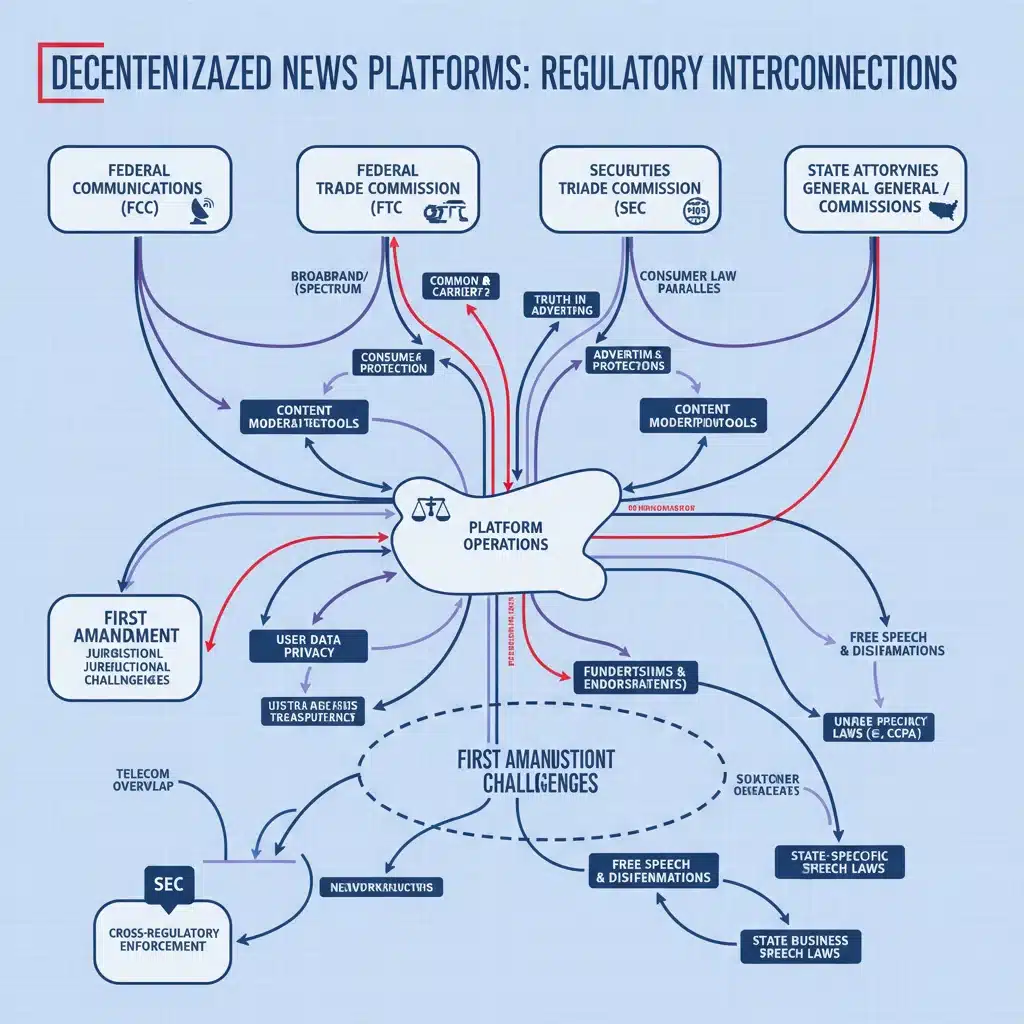
In the US, the regulatory landscape for media and technology is fragmented, with various federal and state agencies holding jurisdiction over different aspects. For decentralized news platforms, several existing frameworks could potentially apply, often with significant ambiguity:
1. Freedom of Speech and the First Amendment
The First Amendment to the US Constitution protects freedom of speech and the press. Decentralized news platforms often champion these principles, arguing that their architecture inherently supports a more open and free exchange of information. However, this protection is not absolute. Laws against defamation, incitement, and copyright infringement still apply. The challenge lies in determining who is responsible for enforcing these laws on a decentralized network where content creators, validators, and platform developers may be geographically dispersed and operate under pseudonyms.
2. Securities Law (SEC)
Many decentralized platforms raise capital through token sales. If these tokens are deemed to be “securities” under the Howey test, they fall under the jurisdiction of the Securities and Exchange Commission (SEC). This could subject platforms to rigorous disclosure requirements, anti-fraud provisions, and registration processes, which are often incompatible with the decentralized ethos. The SEC’s stance on various crypto assets continues to evolve, creating significant uncertainty for tokenized news platforms. Clear guidance on what constitutes a utility token versus a security token is crucial for the future of decentralized news regulation.
3. Consumer Protection (FTC)
The Federal Trade Commission (FTC) is responsible for protecting consumers from deceptive and unfair business practices. This could extend to misleading advertising, scams, or fraudulent content disseminated through decentralized news platforms. While the FTC typically targets entities directly engaged in such practices, the decentralized nature of these platforms makes identifying and holding responsible parties challenging. Questions arise regarding the liability of developers who create the protocols versus the users who publish content.
4. Copyright Law (DMCA)
The Digital Millennium Copyright Act (DMCA) provides a framework for addressing copyright infringement online. While traditional platforms have “safe harbor” provisions if they comply with notice-and-takedown procedures, decentralized platforms present a unique challenge. The immutable nature of blockchain content makes “takedowns” difficult, if not impossible, in the conventional sense. Regulators may need to explore new mechanisms or impose different forms of liability on platform operators or content validators.
5. Data Privacy (State Laws, e.g., CCPA, and potential Federal Law)
While often focused on content, decentralized news platforms also handle user data. State-level data privacy laws like the California Consumer Privacy Act (CCPA) and the prospect of a federal data privacy law could impact how platforms collect, store, and utilize user information, even if pseudonymized. Ensuring compliance with data subject rights, such as the right to erasure, becomes complex when data is stored on an immutable ledger. This aspect of decentralized news regulation is gaining increasing prominence.
The 3-Month Outlook for 2026: Key Trends and Predictions
Looking ahead to the first quarter of 2026, several key trends and potential developments are likely to shape the regulatory environment for decentralized news platforms in the US:
1. Increased Scrutiny on Token Economics and Governance
The SEC is expected to continue its aggressive stance on unregistered securities offerings. Decentralized news platforms utilizing native tokens for governance, content monetization, or staking will face heightened scrutiny. The agency may issue further guidance or enforcement actions to clarify its position on various token classifications. Platforms that can demonstrate genuine decentralization and utility for their tokens, distinct from speculative investment, will be better positioned. The coming months will likely see more platforms proactively seeking legal counsel to structure their tokenomics to mitigate securities risks.
2. Focus on Content Moderation and Liability
The debate around content moderation, especially concerning misinformation, hate speech, and illegal content, will intensify. While decentralized platforms pride themselves on censorship resistance, governments and the public are increasingly demanding accountability for harmful content. We may see legislative proposals attempting to define new categories of liability for decentralized platform developers or those who validate content. This could involve exploring novel legal theories that address the unique challenges of distributed networks, potentially drawing parallels with Section 230 of the Communications Decency Act, but with significant modifications to account for decentralization. This area of decentralized news regulation is particularly contentious.
3. Calls for Industry Self-Regulation and Best Practices
As regulatory uncertainty persists, there will be increasing pressure on the decentralized news industry to develop its own standards and best practices. This could include frameworks for content authenticity, ethical journalism on-chain, and dispute resolution mechanisms. Proactive self-regulation could help demonstrate the industry’s commitment to responsible operation and potentially preempt more stringent government intervention. Collaboration among leading decentralized news platforms to establish a common code of conduct will be crucial in the short term.
4. State-Level Initiatives and Pilots
While federal regulation often moves slowly, individual states may begin to explore their own approaches to regulating decentralized technologies, including news platforms. This could manifest as state-level pilot programs, task forces, or even specific legislation aimed at fostering innovation while addressing local concerns. Platforms operating nationwide will need to monitor these diverse state-level developments closely, as a patchwork of regulations could emerge before a unified federal approach. This fragmented approach adds another layer of complexity to decentralized news regulation.
5. Geopolitical Influences and International Alignment
The US regulatory approach will not exist in a vacuum. International developments, particularly in the European Union with its comprehensive Digital Services Act (DSA) and Digital Markets Act (DMA), will likely influence American policymakers. As decentralized news platforms often operate globally, there will be pressure for some degree of international regulatory alignment or at least interoperability. The US may seek to learn from or adapt elements of international frameworks in its own approach to decentralized news regulation.
Challenges and Opportunities for Decentralized News Platforms
Navigating the anticipated regulatory landscape presents both significant challenges and unique opportunities for decentralized news platforms.
Challenges:
- Legal Ambiguity: The lack of clear definitions and precedents for decentralized autonomous organizations (DAOs), smart contracts, and blockchain-based content makes compliance difficult and costly.
- Jurisdictional Issues: The global and borderless nature of decentralized networks complicates jurisdictional claims, leading to potential conflicts of laws.
- Compliance Costs: Adhering to complex and evolving regulations will require significant legal and technical resources, potentially hindering smaller projects.
- Balancing Decentralization with Accountability: Maintaining the core principles of decentralization while meeting regulatory demands for accountability and governance is a fundamental architectural and philosophical challenge.
- Technological Limitations: Implementing traditional regulatory mechanisms, such as content takedowns or identity verification, can be technically challenging or antithetical to the design of many decentralized platforms.
Opportunities:
- Enhanced Trust and Credibility: Platforms that proactively build compliance into their design can differentiate themselves by offering a more trusted and legitimate news source, appealing to a broader audience.
- Innovation in Compliance: The need for new regulatory approaches can spur innovation in areas like on-chain identity, verifiable credentials, and decentralized dispute resolution mechanisms.
- Advocacy and Education: The regulatory uncertainty creates an opportunity for the decentralized news community to actively engage with policymakers, educate them on the technology, and advocate for sensible, innovation-friendly regulations.
- Global Leadership: The US has an opportunity to lead in establishing a balanced regulatory framework that fosters innovation in decentralized media while protecting public interests.
- New Business Models: Regulatory clarity, even if stringent, can pave the way for more stable and predictable business models, attracting traditional investors and partners.
Strategic Compliance Pathways for 2026
For decentralized news platforms aiming to thrive in the US in 2026, a proactive and strategic approach to compliance is essential. Here are some key pathways:
1. Legal Counsel and Regulatory Monitoring
Engage experienced legal counsel specializing in blockchain and media law. Continuously monitor legislative and regulatory developments at both federal and state levels. This includes tracking proposed bills, agency guidance, and enforcement actions. Membership in industry associations that lobby on behalf of decentralized technologies can also provide valuable intelligence and influence.
2. Proactive Engagement with Policymakers
Don’t wait for regulations to be imposed. Actively engage with policymakers, explaining the benefits and unique challenges of decentralized news. Participate in public consultations, submit comments on proposed rules, and advocate for frameworks that support innovation while addressing legitimate concerns. Education is key to shaping intelligent decentralized news regulation.
3. Designing for Compliance and Transparency
Where possible, design platform architecture with compliance in mind. This might involve:
- Clear Token Utility: Ensure that native tokens have demonstrable utility within the platform, reducing the likelihood of being classified as securities.
- On-Chain Governance: Implement robust and transparent on-chain governance mechanisms that allow for community-driven decision-making, including aspects related to content policy.
- Identity Solutions: Explore decentralized identity (DID) solutions that allow for optional, verifiable identity without compromising user privacy, which could help with accountability.
- Content Provenance: Utilize blockchain to rigorously track content provenance and modifications, enhancing transparency and combating misinformation.

4. Industry Standards and Self-Regulation
Collaborate with other decentralized news projects and industry bodies to develop and adhere to common standards and best practices. This could include codes of conduct for journalists, guidelines for content moderation in a decentralized context, and mechanisms for resolving disputes. A united front can present a more compelling case to regulators and demonstrate industry maturity. Establishing clear community guidelines and transparent enforcement processes, even within a decentralized framework, can significantly aid in navigating decentralized news regulation.
5. Geographic Diversification and Redundancy
Given the potential for diverse regulatory approaches, consider geographic diversification for certain aspects of platform operations, where legally and technically feasible. Building in redundancy and resilience can help platforms weather localized regulatory storms and maintain operational continuity.
6. Embrace Technological Solutions for Regulatory Challenges
Instead of viewing regulation purely as a constraint, consider how blockchain and other decentralized technologies can offer innovative solutions to regulatory challenges. For instance, zero-knowledge proofs could be used to verify compliance without revealing sensitive data, and decentralized arbitration mechanisms could provide alternative dispute resolution. This forward-thinking approach can transform the conversation around decentralized news regulation.
Conclusion: A Dynamic and Evolving Landscape
The 2026 regulatory landscape for decentralized news platforms in the US is poised to be dynamic and complex. While the core principles of censorship resistance and transparency remain attractive, the realities of legal frameworks and public demand for accountability will inevitably lead to increased regulatory attention. The next three months will be critical in observing initial trends, potential legislative proposals, and enforcement actions that will set the tone for the coming years.
For decentralized news platforms, the path forward is not one of avoidance but of proactive engagement, thoughtful design, and strategic compliance. By understanding the existing legal frameworks, anticipating emerging trends, and actively shaping the regulatory dialogue, these platforms can not only survive but thrive, ultimately fulfilling their promise of a more open, transparent, and resilient media ecosystem. The evolution of decentralized news regulation will be a testament to how traditional legal systems adapt to revolutionary technologies.
The journey towards a stable and predictable regulatory environment for decentralized news is just beginning. Stakeholders who prepare now, adapt swiftly, and advocate effectively will be best positioned to lead this exciting new frontier in journalism.