Quantum Computing’s Impact on Data Security: US Journalist Guide 2027
Anúncios
By 2027, US journalists must understand how quantum computing will fundamentally reshape data security, necessitating a proactive approach to reporting on the vulnerabilities and the race for post-quantum cryptographic solutions impacting national security and digital infrastructure.
Anúncios
The digital landscape is hurtling towards a transformative era, where the very foundations of data security as we know it are poised for a radical overhaul. For US journalists, understanding Quantum Computing’s Impact on Data Security: What US Journalists Need to Know by 2027 is no longer a niche topic, but a critical imperative for informed reporting on national security, economic stability, and individual privacy.
The Dawn of the Quantum Threat: An Overview
Quantum computing, while still in its nascent stages, promises to revolutionize fields from medicine to finance. However, this immense power also casts a long shadow over current cryptographic standards. Journalists need to grasp the basics of this impending shift to accurately convey its implications to the public.
The core concern lies in quantum computers’ ability to efficiently solve mathematical problems that are intractable for even the most powerful classical supercomputers. These problems form the bedrock of modern encryption, meaning that widely used algorithms could become obsolete, leaving sensitive data vulnerable.
Understanding Quantum Supremacy and Its Implications
Quantum supremacy refers to the point where a quantum computer can perform a task that a classical computer cannot. While achieving this for practical, large-scale problems is still some years away, the theoretical groundwork for breaking current encryption is already established. This makes it a ticking time bomb for data security.
- Shor’s Algorithm: This quantum algorithm can efficiently factor large numbers, directly threatening RSA encryption.
- Grover’s Algorithm: While not breaking symmetric encryption outright, it significantly speeds up brute-force attacks.
- Harvest Now, Decrypt Later: Adversaries could be collecting encrypted data today, intending to decrypt it once quantum computers are powerful enough.
The implications extend beyond government secrets to corporate intellectual property, financial transactions, and personal information. Journalists must begin framing this as a present danger with future consequences, rather than a distant science fiction concept.
Current Encryption Vulnerabilities and the Quantum Threat
Modern digital security relies heavily on cryptographic algorithms that are computationally difficult for classical computers to break. However, quantum computers possess capabilities that fundamentally undermine these assumptions, creating significant vulnerabilities.
It’s crucial for journalists to understand which types of encryption are most at risk and why. This involves differentiating between symmetric and asymmetric encryption and how quantum algorithms specifically target their underlying mathematical challenges.
Asymmetric Encryption: The Primary Target
Asymmetric encryption, like RSA and Elliptic Curve Cryptography (ECC), forms the basis for secure communication, digital signatures, and key exchange. These methods rely on the difficulty of factoring large numbers or solving elliptic curve discrete logarithm problems.
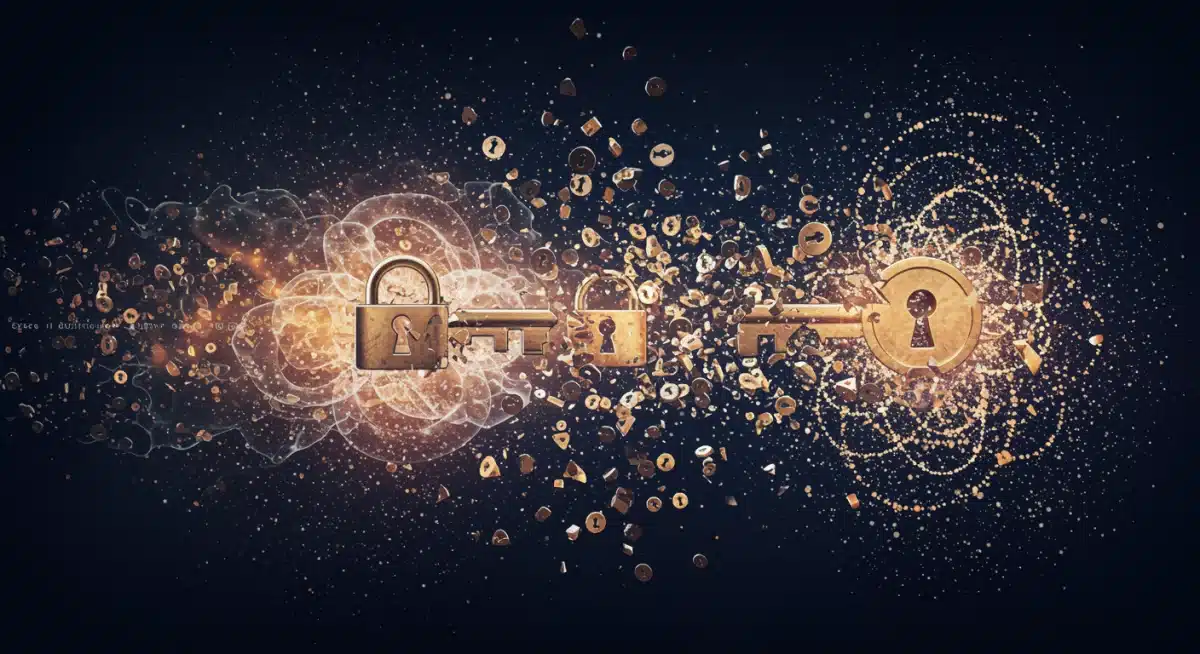
Shor’s algorithm, developed in 1994, provides a polynomial-time solution to these problems, rendering these encryption schemes insecure once fault-tolerant quantum computers become available. This has profound implications for virtually all secure online interactions.
- RSA: Used for secure web browsing (HTTPS), email, and VPNs.
- ECC: Employed in cryptocurrencies, digital certificates, and mobile communication.
- Digital Signatures: Authenticity of software updates, financial transactions, and official documents could be compromised.
Journalists should emphasize that while the immediate threat isn’t here, the time to transition to quantum-resistant alternatives is now, given the long deployment cycles for new cryptographic standards.
The Race for Post-Quantum Cryptography (PQC)
In response to the quantum threat, cryptographers worldwide are engaged in an urgent race to develop and standardize new cryptographic algorithms that can resist attacks from quantum computers. This field is known as Post-Quantum Cryptography (PQC).
Journalists covering this topic should highlight the efforts being made by national and international bodies, the different approaches to PQC, and the challenges involved in their implementation. This is a critical area for public and private sector preparedness.
NIST Standardization Process and Key PQC Candidates
The National Institute of Standards and Technology (NIST) in the US has been leading a multi-year effort to solicit, evaluate, and standardize quantum-resistant cryptographic algorithms. This process is vital for ensuring interoperability and trust in future secure systems.
- Lattice-based Cryptography: Considered a leading candidate, relying on complex mathematical problems related to lattices.
- Code-based Cryptography: Based on error-correcting codes, offering strong security but often with larger key sizes.
- Hash-based Signatures: Provides robust digital signatures, though often with stateful properties that require careful management.
Reporting on the NIST process involves understanding the trade-offs between security, performance, and key sizes for different PQC candidates. Journalists should explain that the transition will be complex and gradual, requiring significant investment and coordination across industries.
National Security Implications for the United States
The potential for quantum computers to break current encryption poses an existential threat to US national security. Classified government communications, military intelligence, and critical infrastructure control systems all rely on cryptographic protection that could be compromised.
For US journalists, this angle is paramount. Reporting must focus on how this threat is being perceived and addressed by defense agencies, intelligence communities, and policymakers, and what the potential fallout of a successful quantum attack could be.
Protecting Classified Information and Critical Infrastructure
Government agencies are acutely aware of the ‘harvest now, decrypt later’ threat. Data collected today, even if encrypted, could be decrypted by a future quantum computer. This necessitates a proactive strategy to protect long-term sensitive information.
Critical infrastructure, including energy grids, financial systems, and transportation networks, is another major concern. A quantum attack on these systems could lead to widespread disruption and catastrophic consequences. Journalists should explore:
- Government Initiatives: What steps are agencies like the NSA and CISA taking to prepare?
- International Cooperation: How are the US and its allies collaborating on PQC research and deployment?
- Supply Chain Risks: The vulnerability of cryptographic components within the defense supply chain.
The national security implications are not just about espionage but also about maintaining technological superiority and ensuring the resilience of essential services against state-sponsored quantum threats.
Economic and Business Impacts: A Looming Crisis
Beyond national security, the advent of quantum computing threatens to unleash unprecedented economic disruption. Industries reliant on secure data, from banking and healthcare to e-commerce and intellectual property, face significant risks if they fail to adapt.
Journalists should investigate how businesses are preparing for this shift, the potential costs of transitioning to PQC, and the competitive advantages or disadvantages that early or late adopters might experience. This is a story with major financial ramifications.
Financial Sector Vulnerabilities and Data Breaches
The financial sector, with its constant flow of sensitive transactions and personal data, is particularly exposed. Quantum attacks could compromise bank transfers, credit card information, and customer identities.
Similarly, healthcare records, intellectual property, and trade secrets are all at risk. The cost of a quantum-enabled data breach could be astronomical, both in financial terms and in terms of lost trust and reputation. Key areas for journalistic inquiry include:
- Banking Systems: How will institutions like the Federal Reserve and major banks upgrade their encryption?
- E-commerce Security: The future of secure online shopping and payment gateways.
- Intellectual Property: Protecting patents, research, and development from quantum-enabled industrial espionage.
The economic impact will also involve the burgeoning market for quantum-safe solutions, creating new opportunities and challenges for tech companies and cybersecurity firms.
Reporting Challenges and Ethical Considerations for Journalists
Covering quantum computing and its impact on data security presents unique challenges for journalists. The technical complexity, the speculative nature of future threats, and the potential for fear-mongering require a nuanced and responsible approach.
Journalists must navigate these complexities to provide accurate, balanced, and actionable information to their audiences. Ethical considerations, such as avoiding sensationalism while conveying urgency, are paramount.
Translating Complexity and Avoiding Hype
The highly technical nature of quantum mechanics and cryptography can make it difficult to explain to a general audience. Journalists need to develop strategies for simplifying complex concepts without oversimplifying or misrepresenting them.
Furthermore, the field is prone to hype and exaggerated claims. It’s essential to distinguish between genuine scientific progress and marketing spin. Ethical reporting means:
- Fact-Checking: Verifying claims with leading experts and peer-reviewed research.
- Contextualization: Placing developments within a broader timeline and technological landscape.
- Source Credibility: Relying on reputable scientists, government agencies, and established research institutions.
The goal is to inform, not alarm, and to prepare the public for a future that will undoubtedly be shaped by quantum advancements. Journalists play a critical role in fostering public understanding and preparedness for this significant technological shift.
| Key Aspect | Brief Description |
|---|---|
| Quantum Threat | Quantum computers can break current encryption (RSA, ECC), jeopardizing secure data. |
| Post-Quantum Cryptography (PQC) | Development of new encryption immune to quantum attacks, led by NIST standardization. |
| National Security | Critical US government and infrastructure data at risk; urgent need for quantum-safe transition. |
| Economic Impact | Financial, healthcare, and IP sectors face significant data breach risks and transition costs. |
Frequently Asked Questions About Quantum Data Security
The primary threat is quantum computers’ ability to efficiently break asymmetric encryption algorithms like RSA and ECC, which secure most of our digital communications and transactions. This could expose sensitive data, compromise digital signatures, and undermine global cybersecurity infrastructure.
While exact timelines vary, many experts predict that cryptographically relevant quantum computers could emerge within the next 5-15 years, potentially by 2027 for some initial capabilities. The ‘harvest now, decrypt later’ strategy means data encrypted today could be compromised in the future.
PQC refers to new cryptographic algorithms designed to be resistant to attacks from both classical and quantum computers. Organizations like NIST are actively standardizing these algorithms to provide secure alternatives before quantum computers become a widespread threat.
US national security faces significant risks, including the potential compromise of classified government communications, military intelligence, and critical infrastructure control systems. The transition to PQC is a top priority for defense and intelligence agencies to maintain secure operations.
Journalists are crucial in translating complex technical information into accessible content, raising public awareness, and holding institutions accountable for preparedness. They must avoid sensationalism while accurately conveying the urgency and long-term implications of quantum computing for data security.
Conclusion
The impending impact of quantum computing on data security is not a distant concern but a present challenge demanding immediate attention from US journalists. By 2027, the groundwork for a quantum-safe future must be firmly in place, and the public needs to be informed about the vulnerabilities, the ongoing race for post-quantum cryptographic solutions, and the profound implications for national security, economic stability, and individual privacy. Journalists have a vital role in demystifying this complex topic, fostering informed public discourse, and ensuring that the United States is prepared for the quantum era.