Decentralized News: US Economic Advantages 2026 Report

The Economic Advantages of Decentralized News Consumption for US Audiences: A 2026 Financial Impact Report
In an era defined by rapid technological advancement and an insatiable demand for information, the landscape of news consumption is undergoing a profound transformation. Traditional media models, long reliant on centralized control and advertising revenue, are increasingly being challenged by innovative, decentralized approaches. This report delves into the burgeoning phenomenon of Decentralized News Economy, specifically focusing on its economic advantages for US audiences and projecting its financial impact by the year 2026.
The concept of decentralized news is not merely a technological novelty; it represents a fundamental shift in how information is created, distributed, and consumed. By leveraging technologies such as blockchain, peer-to-peer networks, and cryptographic principles, decentralized news platforms aim to address some of the most pressing issues plaguing traditional media: censorship, misinformation, bias, and opaque financial structures. For US audiences, this paradigm shift promises not only greater access to diverse and credible information but also significant economic benefits that extend beyond mere consumer choice.
Understanding the Decentralized News Economy
At its core, the Decentralized News Economy operates on principles that diverge sharply from its centralized predecessors. Instead of a few large media conglomerates controlling the flow of information, decentralized systems empower individual creators, fact-checkers, and even consumers to participate in the news ecosystem. This participation is often incentivized through token-based economies, where contributions are rewarded with digital assets that hold real-world value.
Key Pillars of Decentralization in News:
- Blockchain Technology: Provides an immutable and transparent ledger for recording news articles, sources, and editorial decisions, bolstering trust and traceability.
- Peer-to-Peer Networks: Enables direct distribution of content, bypassing intermediaries and reducing the risk of censorship or single points of failure.
- Tokenomics: Utilizes cryptocurrencies or utility tokens to reward content creators, curators, and validators, fostering a vibrant and self-sustaining ecosystem.
- Community Governance: Empowers users to have a say in content moderation, platform development, and even funding decisions, promoting a more democratic news environment.
The transition to a Decentralized News Economy is not without its challenges, but the potential rewards, particularly for US audiences, are substantial. As we move towards 2026, the financial implications of this shift are becoming increasingly clear, pointing towards a more equitable, efficient, and resilient information landscape.
Economic Advantages for US Audiences by 2026
The economic benefits of a decentralized news model for US audiences are multi-faceted, impacting various stakeholders from individual consumers to the broader economic fabric. By 2026, we anticipate several key advantages to materialize.
1. Reduced Costs of Access and Increased Value for Money
Traditional news media often comes with hefty subscription fees or is heavily reliant on intrusive advertising. In a decentralized model, the cost structure is fundamentally different. Many platforms offer micro-payments for individual articles, allowing consumers to pay only for the content they genuinely value, rather than subscribing to an entire publication they may only partially read. This ‘pay-per-article’ or ‘pay-for-value’ model significantly reduces the overall cost of news consumption for the average US household.
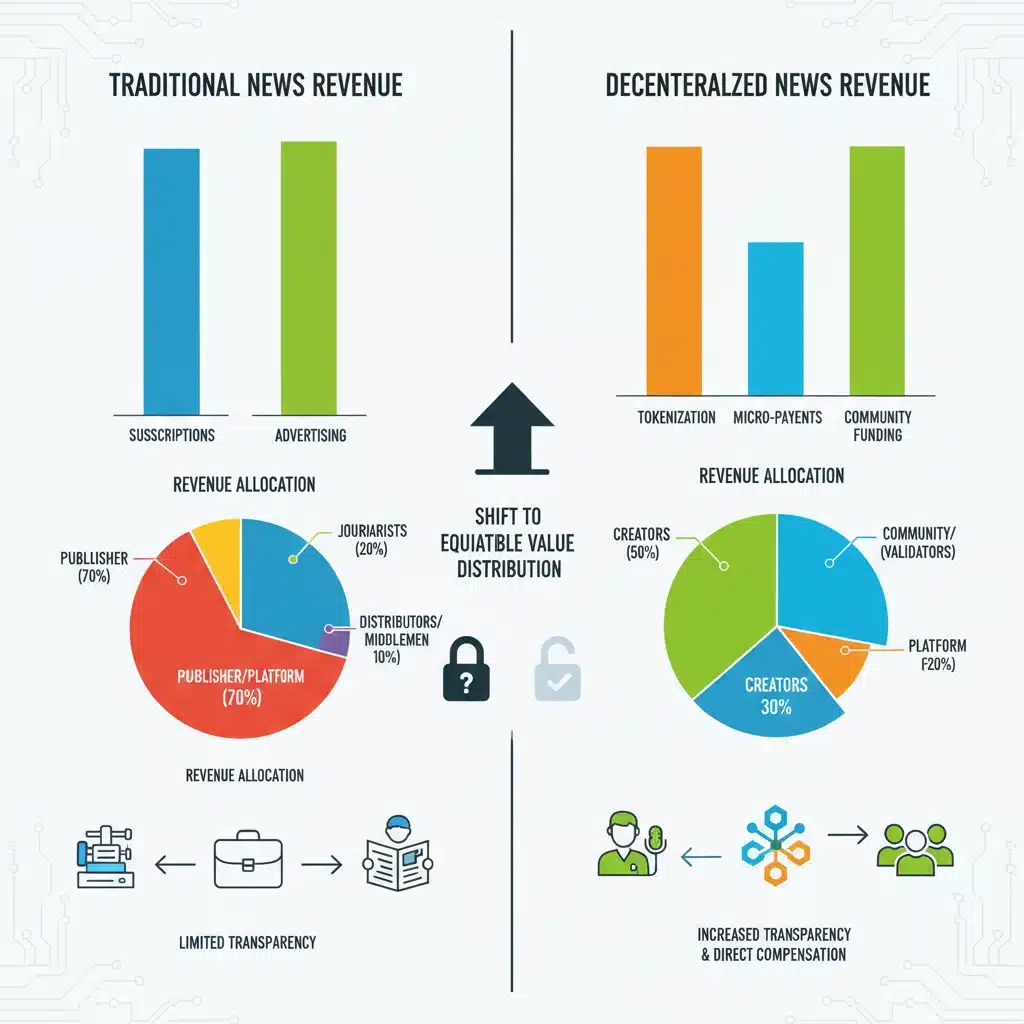
Furthermore, the elimination of intermediaries in content distribution means that a larger share of revenue can go directly to content creators. This incentivizes higher quality journalism, as creators are directly rewarded for their valuable contributions, leading to a richer and more diverse news offering without necessarily increasing the financial burden on consumers. By 2026, we expect a notable shift in consumer spending habits, with more disposable income freed up from traditional news subscriptions being reallocated to other goods and services, or to directly support independent journalists and platforms within the Decentralized News Economy.
2. Enhanced Trust and Reduced Economic Impact of Misinformation
The proliferation of misinformation has significant economic costs, ranging from market volatility caused by false financial news to public health crises exacerbated by inaccurate health information. A decentralized news ecosystem, with its inherent transparency and immutability, offers a powerful antidote. Blockchain-based verification mechanisms can track the provenance of news stories, making it easier to identify and discount unreliable sources.
For US businesses and consumers, this translates to more reliable data for decision-making, leading to better investment choices, more informed consumer behavior, and a more stable economic environment. A 2026 projection suggests that a reduction in the economic impact of misinformation, even by a small percentage, could save the US economy billions of dollars annually by preventing market manipulation, fraudulent schemes, and inefficient resource allocation. The enhanced trust inherent in a Decentralized News Economy builds a more robust informational foundation for economic activity.
3. Democratization of Content Creation and New Economic Opportunities
The high barriers to entry in traditional journalism often limit who can become a news producer. Decentralized platforms, however, lower these barriers significantly. Anyone with a compelling story, verified facts, and a commitment to journalistic integrity can contribute and be rewarded. This democratization fosters a new class of independent journalists, citizen reporters, and specialized content creators across the US.
This shift creates new economic opportunities, particularly for individuals in underserved communities or those with niche expertise. Freelance journalists, who often struggle with unstable income, can find more consistent and equitable compensation models within a tokenized Decentralized News Economy. By 2026, we anticipate a measurable increase in the number of independent content creators and a diversification of news topics, catering to a wider array of interests and perspectives within the US populace. This not only enriches the information landscape but also stimulates local economies through new job creation and entrepreneurial ventures.
4. Increased Competition and Innovation in the Media Sector
The dominance of a few large media entities can stifle innovation and limit consumer choice. The rise of decentralized news platforms introduces a new competitive dynamic. Smaller, agile, and technologically advanced platforms can challenge established players by offering superior user experiences, more transparent reporting, and more attractive compensation models for creators.
This increased competition drives innovation across the entire media sector. Traditional news organizations will be compelled to adapt, adopt new technologies, and improve their offerings to retain audiences. This competitive pressure ultimately benefits US consumers through higher quality content, more efficient delivery mechanisms, and a broader spectrum of news products and services. By 2026, the Decentralized News Economy is expected to be a significant catalyst for technological and editorial innovation within the US media landscape, pushing boundaries and fostering a more dynamic industry.
5. Resilience Against Economic Shocks and Censorship
Centralized news organizations are vulnerable to various economic shocks, such as advertising downturns or ownership changes, which can lead to layoffs, reduced coverage, or even closures. They are also susceptible to government or corporate censorship due to their centralized points of control.
Decentralized networks, by their very nature, are more resilient. Their distributed infrastructure means there is no single point of failure, making them harder to shut down or censor. Furthermore, diverse funding models, often involving community contributions and token-based incentives, can make them less reliant on volatile advertising markets. This resilience ensures a more stable and continuous flow of information to US audiences, even during times of economic instability or political pressure. By 2026, the strategic importance of a resilient Decentralized News Economy will be evident in its ability to maintain informational integrity and access during crises, thereby safeguarding democratic processes and public discourse.
The Role of US Audiences in Shaping the Decentralized News Economy
US audiences are not passive recipients in this evolving landscape; they are active participants. Their choices, engagement, and willingness to embrace new models will largely determine the pace and extent of the Decentralized News Economy‘s growth. By actively seeking out and supporting decentralized platforms, consumers can accelerate the shift towards a more transparent and equitable news environment.
Consumer Empowerment and Influence:
- Direct Funding: US audiences can directly support journalists and platforms they trust through micro-payments or token purchases, ensuring their favorite content creators remain viable.
- Content Curation and Validation: Many decentralized platforms allow users to rate, review, and even fact-check content, contributing to the overall quality and credibility of information.
- Community Governance: Participation in decentralized autonomous organizations (DAOs) associated with news platforms gives users a voice in editorial policies and platform development.
- Reduced Ad-Blocker Usage: With less reliance on intrusive advertising, consumers may be more inclined to disable ad-blockers, indirectly supporting the platform and its creators.
This active role transforms news consumption into a more engaged and impactful activity, fostering a sense of ownership and community around trusted information sources. The collective power of US audiences can steer the Decentralized News Economy towards models that prioritize truth, transparency, and public benefit over profit and control.
Challenges and Considerations for 2026
While the economic advantages are compelling, the path to a fully mature Decentralized News Economy by 2026 is not without its hurdles. Several challenges need to be addressed to realize the full potential of this shift.
1. Scalability and User Adoption:
Current blockchain technologies, while powerful, sometimes face scalability issues that can impact transaction speeds and costs. For mass adoption by US audiences, decentralized news platforms need to offer seamless, intuitive user experiences that are comparable to, or even surpass, traditional media outlets. Onboarding new users to crypto-native platforms can be complex, and simplifying this process will be crucial.
2. Regulatory Clarity:
The regulatory landscape for cryptocurrencies and decentralized applications (dApps) in the US is still evolving. Uncertainty around token classification, taxation, and consumer protection can hinder innovation and investment in the Decentralized News Economy. Clear and supportive regulatory frameworks will be essential for fostering growth and ensuring legal compliance.
3. Combating Sophisticated Misinformation:
While decentralization offers tools to combat misinformation, sophisticated actors may still attempt to exploit vulnerabilities. Developing robust AI-powered fact-checking, reputation systems, and community moderation tools will be ongoing challenges. The sheer volume of information can also make it difficult for users to discern quality content, necessitating effective discovery and filtering mechanisms.
4. Interoperability and Standardization:
As multiple decentralized news platforms emerge, ensuring interoperability between them and establishing common standards for content verification, metadata, and tokenomics will be important. A fragmented ecosystem could create friction for users and creators, limiting the overall network effect of the Decentralized News Economy.

Forecasting the Financial Impact by 2026
Projecting the exact financial impact of the Decentralized News Economy by 2026 involves several variables, but key trends suggest significant growth and a reallocation of economic value.
Market Size and Investment:
The global market for decentralized applications is projected to grow substantially, and the news sector will be a significant beneficiary. By 2026, we could see billions of dollars in venture capital and community funding flowing into decentralized news projects. This investment will drive technological development, platform expansion, and content creation, directly impacting the US market.
Revenue Reallocation:
A conservative estimate suggests that a significant percentage of current advertising revenue and subscription fees from traditional media could shift towards decentralized models. This reallocation would empower creators and reduce the financial burden on consumers. For instance, if even 5-10% of the US digital advertising market for news (estimated at tens of billions annually) were to shift to decentralized models, it would represent a substantial economic transfer.
Job Creation:
The growth of the Decentralized News Economy will create new jobs in blockchain development, content creation, community management, fact-checking, and platform governance. This will contribute to overall economic growth and diversify the employment landscape within the US tech and media sectors.
Increased Economic Efficiency:
By reducing the costs associated with intermediaries, advertising fraud, and content distribution, decentralized news platforms offer a more efficient economic model. This efficiency translates into savings for publishers and consumers, and more direct value for creators.
Conclusion: A New Era for News and the US Economy
The advent of the Decentralized News Economy marks a pivotal moment for information consumption in the United States. By 2026, the economic advantages for US audiences are expected to be profound, encompassing reduced costs, enhanced trust, new economic opportunities, increased competition, and greater resilience.
This shift is not merely about technology; it’s about re-establishing the foundational principles of journalism: truth, transparency, and public service, within an economic framework that rewards these values. While challenges remain, the trajectory towards a more decentralized and equitable news landscape is clear. US audiences, by embracing and actively participating in this transformation, stand to gain significantly, fostering a more informed, engaged, and economically robust society.
The future of news is decentralized, and its economic impact on the US by 2026 promises to be transformative, ushering in an era where information truly serves the public good and empowers its creators and consumers alike. Investing in and understanding this evolving ecosystem is not just a technological imperative; it’s an economic opportunity that the United States cannot afford to overlook.