Combatting Disinformation: A 4-Step Blockchain Verification Process for US Crypto News in 2026

Combatting Disinformation: A 4-Step Blockchain Verification Process for US Crypto News in 2026
The year is 2026. The cryptocurrency market, once a wild west of speculative trading and often unreliable information, has matured significantly. Yet, one persistent challenge remains: disinformation. The rapid spread of false or misleading news can manipulate markets, erode investor confidence, and undermine the legitimacy of digital assets. In an era where information is power, ensuring the veracity of crypto news is paramount. This article explores a revolutionary 4-step blockchain verification process designed to combat disinformation in US crypto news, fostering an unprecedented level of trust and transparency.
The digital landscape is rife with sources claiming to offer the latest insights into the crypto world. From social media influencers to obscure forums, the sheer volume of information can be overwhelming. Distinguishing fact from fiction has become a full-time job for many, and even seasoned investors can fall prey to carefully crafted narratives. The implications of this disinformation are far-reaching, impacting not only individual financial decisions but also the broader regulatory environment and public perception of cryptocurrencies. As the industry continues its trajectory towards mainstream adoption, the need for robust mechanisms to validate information becomes increasingly critical. This is where blockchain crypto verification steps in as a game-changer.
The Urgent Need for Trust in Crypto News
Before diving into the mechanics of the solution, it’s essential to understand the gravity of the problem. Disinformation in crypto news isn’t just about sensational headlines; it often involves deliberate attempts to manipulate prices, launch pump-and-dump schemes, or create FUD (Fear, Uncertainty, and Doubt) to drive down asset values for personal gain. These tactics can decimate portfolios, particularly for retail investors who may lack the resources or expertise to conduct thorough due diligence. The decentralized nature of cryptocurrencies, while a core strength, also presents unique challenges for information control, making it easier for unverified claims to spread rapidly across global networks.
Furthermore, the regulatory landscape for cryptocurrencies is still evolving. Governments and financial institutions are grappling with how to integrate digital assets into existing frameworks. A constant barrage of unverified news can complicate these efforts, leading to knee-jerk reactions, over-regulation, or a general distrust that stifles innovation. For the US market, which often sets global precedents, establishing a gold standard for blockchain crypto verification in news reporting is not just beneficial but essential for its continued leadership in the digital economy. By 2026, with the anticipated growth of institutional investment and widespread adoption, the integrity of crypto news will directly correlate with market stability and investor protection.
Introducing the 4-Step Blockchain Verification Process
Our proposed 4-step blockchain verification process is designed to bring unprecedented transparency and accountability to crypto news reporting. It leverages the inherent properties of blockchain technology – immutability, decentralization, and cryptographic security – to create a verifiable chain of custody for information. This framework aims to empower readers, journalists, and platforms alike to ascertain the authenticity of news at a glance, transforming the way we consume and trust digital asset information.
Step 1: Source Registration and Identity Verification
The first critical step in establishing trust is knowing the source. This involves a rigorous registration process for news organizations, independent journalists, and even expert commentators who wish to publish verifiable crypto news. Each registered entity would undergo a comprehensive identity verification process, potentially utilizing decentralized identity (DID) solutions. Once verified, a unique, cryptographically secured identifier (a public key) would be associated with their publishing entity on a dedicated blockchain network. This identifier acts as a digital signature for all subsequent publications.
This registration would not just be a one-time event but an ongoing process, with reputation scores built into the system. News sources that consistently publish accurate, verified information would accrue higher reputation scores, making their content more visible and trusted. Conversely, sources found to disseminate disinformation would see their scores plummet, or even face suspension from the verification network. This creates a powerful incentive for journalistic integrity and responsible reporting. The foundation of blockchain crypto verification rests on establishing trusted origins.
Step 2: Content Hashing and Timestamping
Once a news article, report, or analysis is finalized by a registered source, it undergoes a crucial cryptographic process. The entire content of the article – text, images, videos, and any associated data – is converted into a unique, fixed-length string of characters known as a cryptographic hash. This hash acts as a digital fingerprint of the content. Even a single character change in the original article would result in an entirely different hash, making any tampering immediately detectable.
This hash, along with a precise timestamp of when the content was created and published, is then immutably recorded on the blockchain. This effectively creates an unalterable record of the news article’s existence at a specific point in time. Future attempts to modify the article would yield a different hash, which would not match the one recorded on the blockchain, thus exposing any post-publication alterations. This step is fundamental to ensuring the integrity and immutability of the information, a cornerstone of effective blockchain crypto verification.
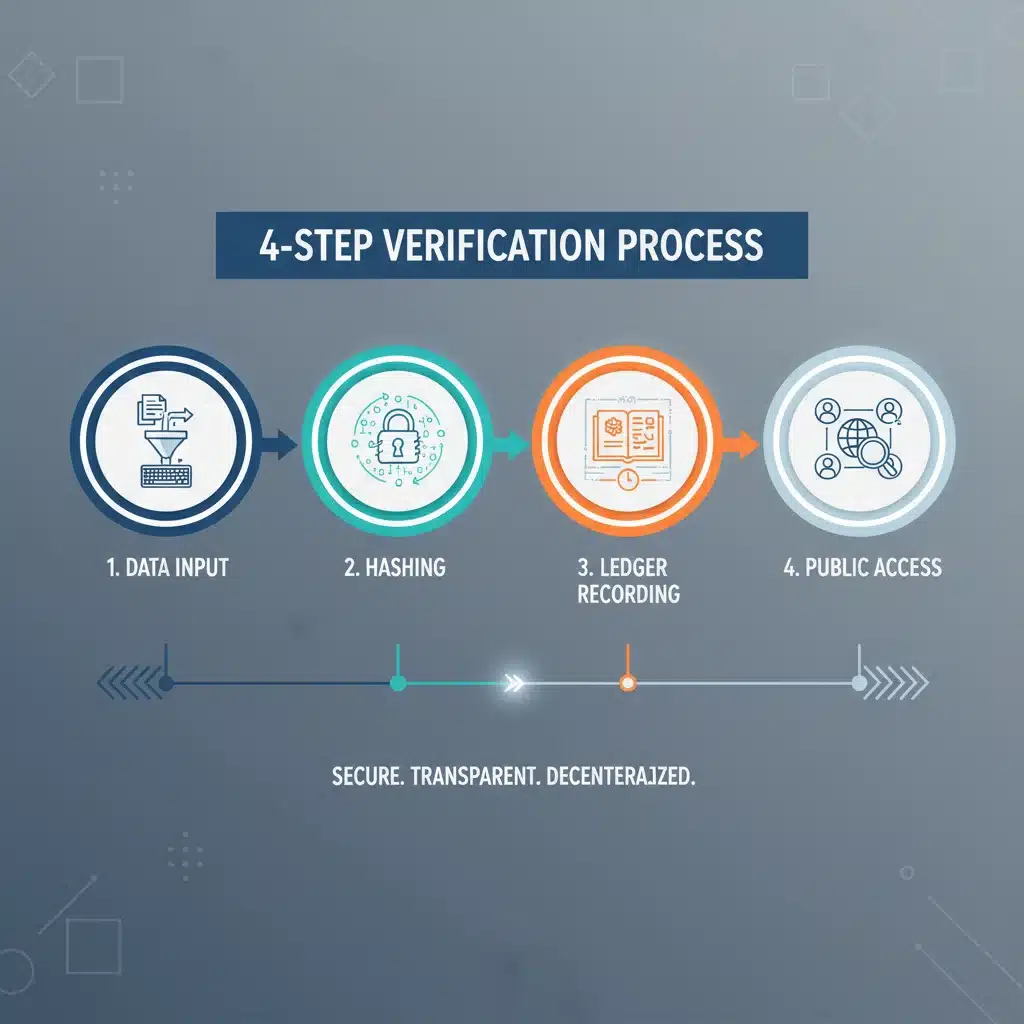
Step 3: Distributed Ledger Recording and Public Access
The hashed content and timestamp, along with the source’s verified identifier, are then broadcasted across the blockchain network and recorded on its distributed ledger. This means that multiple independent nodes maintain a copy of this record. The decentralized nature of the blockchain ensures that no single entity can control or alter the data. Once a block containing this information is added to the chain, it becomes virtually impossible to remove or modify without consensus from the majority of the network participants, which is computationally infeasible.
This step makes the verification process publicly accessible and auditable. Any user, platform, or regulator can independently verify the authenticity of a news piece by comparing its current hash to the one recorded on the blockchain. Special browser extensions or dedicated verification tools could be developed to automate this process, providing real-time indicators of content authenticity. This democratizes trust, moving away from centralized gatekeepers and towards a community-driven, cryptographically secured system of blockchain crypto verification.
Step 4: Community Review and Dispute Resolution
While the first three steps provide a technical foundation for immutability and source verification, human oversight and community engagement are still crucial. This final step introduces a decentralized community review and dispute resolution mechanism. If a user or a group of users identifies a piece of news that they believe to be false or misleading, despite its blockchain verification (perhaps the original source itself was compromised or made an error), they can flag it.
This flagging would initiate a decentralized review process, potentially involving a panel of vetted community members or even AI-powered analysis tools. Evidence would be presented, and a consensus mechanism (e.g., a decentralized autonomous organization – DAO – vote) would determine the validity of the claim. If the news is indeed found to be disinformation, a public ‘disputed’ or ‘debunked’ tag would be associated with its blockchain record, alongside the original verified hash. This doesn’t remove the original record (maintaining immutability) but provides crucial context and warnings to future readers. This iterative feedback loop is vital for the long-term effectiveness of blockchain crypto verification.
Benefits of Blockchain Crypto Verification in US News by 2026
The implementation of this 4-step process promises a multitude of benefits for the US crypto news landscape:
- Enhanced Trust and Credibility: By providing a verifiable audit trail for news content, investors and the general public can have greater confidence in the information they consume, leading to more informed decisions.
- Reduced Market Manipulation: The ability to quickly identify and flag disinformation will significantly reduce the effectiveness of pump-and-dump schemes and other market manipulation tactics.
- Empowered Journalists: Reputable news organizations and journalists will gain a powerful tool to distinguish their work from unverified sources, enhancing their brand and authority.
- Improved Regulatory Clarity: Regulators will have a clearer picture of information flows and potential sources of market instability, enabling more targeted and effective policy-making.
- Increased Investor Protection: Retail investors, often the most vulnerable to disinformation, will be better equipped to identify reliable news sources and avoid scams.
- Faster Dispute Resolution: The community review mechanism allows for quicker and more transparent resolution of disputes regarding news accuracy, reducing the spread of false narratives.
- Global Standard for Digital Media: The success of such a system in the US could set a precedent for global adoption, creating a more trustworthy digital media ecosystem worldwide.
Challenges and Considerations for Implementation
While the benefits are clear, implementing such a comprehensive blockchain crypto verification system is not without its challenges:
- Scalability: The blockchain network must be able to handle a vast volume of news content and verification requests without compromising speed or cost. Layer 2 solutions and efficient consensus mechanisms will be crucial.
- Adoption and Interoperability: Widespread adoption by news organizations, platforms, and users is essential. Interoperability with existing news distribution channels and content management systems will be key.
- User Experience: The verification process must be seamless and intuitive for end-users. Complex technical hurdles will deter adoption.
- Governance and Decentralization: Establishing a truly decentralized and fair governance model for the community review and dispute resolution mechanism will be critical to prevent censorship or bias.
- Cost: Running and maintaining a robust blockchain network involves computational and energy costs, which need to be managed sustainably.
- Resistance from Bad Actors: Those who profit from disinformation will undoubtedly resist such a system, requiring robust security measures and continuous innovation.
Overcoming these challenges will require a collaborative effort from blockchain developers, news organizations, regulatory bodies, and the wider crypto community. Strategic partnerships and open-source development will be instrumental in building a resilient and widely accepted blockchain crypto verification framework.

The Road Ahead: 2026 and Beyond
By 2026, the aspiration is for this 4-step blockchain crypto verification process to be a standard feature across major US crypto news platforms. Imagine a future where every crypto news article comes with a small, verifiable badge, instantly assuring readers of its authenticity and source. This would not only elevate the quality of information but also foster a more mature and responsible crypto ecosystem.
The evolution of this system will likely involve integration with AI for automated content analysis, advanced cryptographic techniques for privacy-preserving verification, and even the tokenization of reputation scores to incentivize participation and good behavior. The goal is to create a self-sustaining ecosystem where truth is rewarded, and disinformation is systematically marginalized.
The journey towards a fully verified crypto news landscape is ambitious, but the foundational technology is already here. Blockchain’s ability to create immutable, transparent, and auditable records makes it the ideal candidate for addressing the pervasive problem of disinformation. As the crypto market continues to expand and mature, the demand for reliable information will only intensify. By embracing innovative solutions like this 4-step verification process, the US can lead the way in establishing a new paradigm for trust and integrity in digital media, securing a more stable and prosperous future for digital assets.
Conclusion
The fight against disinformation in the rapidly evolving world of cryptocurrencies is a battle for trust. A 4-step blockchain crypto verification process – encompassing source registration, content hashing and timestamping, distributed ledger recording, and community review – offers a robust and scalable solution. By 2026, this framework has the potential to transform how US citizens consume crypto news, providing a bulwark against manipulation and fostering a new era of transparency. The future of crypto hinges not just on technological innovation, but on the integrity of the information that guides its adoption and understanding. Embracing blockchain for news verification is not merely an option; it is a necessity for the sustainable growth and legitimization of the digital asset economy.