Tokenized Content: Boosting Crypto Journalist Revenue by 20% by Q3 2026

The landscape of journalism is in constant flux, and for those navigating the dynamic world of cryptocurrency, the challenges and opportunities are amplified. Traditional revenue models are often insufficient to sustain high-quality, in-depth reporting, pushing journalists to seek innovative solutions. This article delves into a groundbreaking approach: tokenized content revenue. We will explore how US crypto journalists can strategically leverage blockchain technology and tokenization to not only stabilize but significantly increase their income, targeting an ambitious 20% revenue boost by Q3 2026.
The Evolving Challenge for Crypto Journalists
Crypto journalism demands a unique blend of technical understanding, market insight, and journalistic integrity. However, the specialized nature of the field often means a smaller, albeit highly engaged, audience. Traditional advertising models, paywalls, and subscription services, while viable, often struggle to capture the full value of the niche expertise offered by crypto journalists. The inherent volatility of the crypto market also impacts advertising budgets, making stable revenue generation a persistent concern.
The current media ecosystem faces several hurdles:
- Ad Revenue Declines: Digital advertising, while pervasive, is increasingly fragmented and often yields diminishing returns for specialized content creators.
- Paywall Fatigue: Audiences are inundated with subscription options, leading to ‘paywall fatigue’ and resistance to adding new subscriptions.
- Platform Dependence: Journalists often rely on centralized platforms (social media, news aggregators) that control distribution and monetization, leaving creators vulnerable to algorithm changes and content policies.
- Lack of Direct Engagement: Traditional models often create a distance between content creators and their most loyal readers, limiting opportunities for direct support and community building.
It’s within this challenging environment that tokenized content revenue emerges as a powerful, transformative solution, offering a path to greater autonomy, direct monetization, and enhanced community engagement for US crypto journalists.
Understanding Tokenized Content Revenue
At its core, tokenized content revenue involves transforming journalistic output into digital assets (tokens) on a blockchain. These tokens can represent ownership, access rights, or even fractional shares of intellectual property. This paradigm shift moves beyond traditional content consumption, allowing journalists to create new, direct monetization channels with their audience.
There are several key mechanisms through which tokenization can generate revenue:
1. Non-Fungible Tokens (NFTs) for Exclusive Content
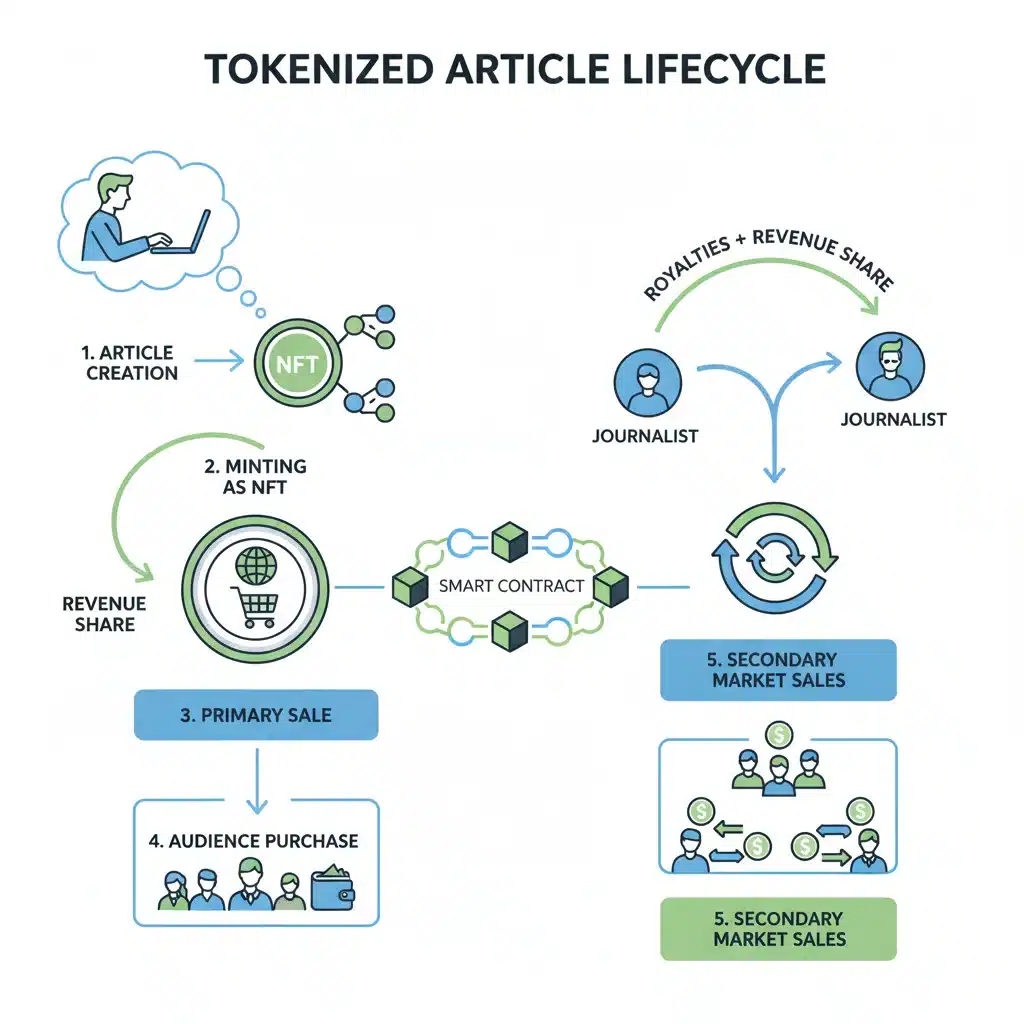
NFTs have revolutionized digital ownership, and their application in journalism is gaining traction. A crypto journalist can mint an article, an investigative report, an exclusive interview transcript, a unique data visualization, or even a series of behind-the-scenes notes as an NFT. Buyers of these NFTs gain verifiable ownership of that specific digital item, often accompanied by exclusive access or privileges.
Consider the following NFT strategies for boosting tokenized content revenue:
- Limited Edition Articles: Minting a highly anticipated analysis or investigative piece as a limited series of NFTs. Owners might get early access, special commentary, or even a signed digital copy.
- Archival Access Passes: Creating NFTs that grant lifetime or timed access to a journalist’s entire archive of premium content.
- Journalistic Artifacts: Tokenizing unique digital artifacts related to a story, such as original research data, audio recordings (with consent), or behind-the-scenes photographs.
- Patronage NFTs: Offering NFTs that function as a form of patronage, where holders receive exclusive perks, community roles, or direct communication channels with the journalist.
The beauty of NFTs lies in their provable scarcity and the ability for secondary market sales. When an NFT is resold, the original creator (the journalist) can receive a royalty percentage from each subsequent sale, creating a perpetual revenue stream that traditional models simply cannot offer.
2. Creator Tokens and Social Tokens
Creator tokens, or social tokens, are fungible cryptocurrencies issued by an individual or a brand. For a crypto journalist, launching a personal creator token allows them to build a micro-economy around their work and community. These tokens can be used for:
- Access to Gated Content: Holding a certain amount of the journalist’s token could grant access to premium articles, private Discord channels, or exclusive Q&A sessions.
- Community Governance: Token holders might gain voting rights on editorial decisions, future content topics, or even the direction of the journalist’s brand. This fosters a deeper sense of ownership and engagement.
- Tipping and Rewards: Readers can use the journalist’s token to directly tip them for valuable content, bypassing platform fees.
- Staking for Perks: Readers might stake (lock up) tokens to earn rewards, gain higher tiers of access, or participate in exclusive events.
The value of a creator token is often tied to the journalist’s reputation, the quality of their content, and the engagement of their community. As the journalist’s influence grows, so too can the value of their token, benefiting both the journalist and their early supporters.
3. Decentralized Autonomous Organizations (DAOs) for Journalism
DAOs represent a radical shift in how organizations are structured and governed. A journalism DAO could be formed by a collective of crypto journalists, or even by a single journalist and their community. In a journalism DAO, token holders (who could be readers, contributors, or patrons) collectively make decisions on funding projects, commissioning articles, editing content, and distributing revenue.
How DAOs contribute to tokenized content revenue:
- Community-Funded Journalism: The DAO’s treasury, funded by token sales or contributions, can directly commission investigative pieces or pay journalists for their work, bypassing traditional publishers.
- Revenue Sharing: Revenue generated from tokenized content (NFT sales, creator token utilities) can be distributed transparently among DAO members or contributors based on predefined rules.
- Curation and Quality Control: Token holders can vote on content quality, fact-checking, and editorial standards, incentivizing high-quality journalism.
- Decentralized Distribution: Content can be published and archived on decentralized storage networks, making it censorship-resistant and permanently accessible.
While DAOs are complex to set up and govern, they offer the ultimate vision of a truly independent, community-driven media model that can significantly enhance tokenized content revenue for participating journalists.
Strategic Implementation for US Crypto Journalists
Achieving a 20% revenue increase by Q3 2026 through tokenized content revenue requires a strategic, phased approach. It’s not about abandoning existing revenue streams but augmenting them with blockchain-native solutions.
Phase 1: Education and Experimentation (Q4 2023 – Q2 2024)
The initial phase involves understanding the technology and experimenting with small-scale projects.
- Deep Dive into Blockchain: Journalists need to thoroughly understand NFTs, smart contracts, various blockchain platforms (Ethereum, Polygon, Solana, etc.), and wallet management.
- Pilot NFT Project: Start by minting a single, high-value piece of content (e.g., an exclusive analysis of a major crypto event) as an NFT on a user-friendly platform. Promote it to your existing audience.
- Community Engagement: Gauge audience interest and feedback. Are your readers willing to engage with tokenized content? What kind of content do they value most as an NFT?
- Legal and Tax Considerations: US crypto journalists must consult with legal and tax professionals regarding the implications of selling digital assets and receiving cryptocurrency income. This is crucial for compliance and sustainable growth.
Phase 2: Scaling and Integration (Q3 2024 – Q2 2025)
Once initial experiments prove successful, the focus shifts to scaling and integrating tokenized content into a broader revenue strategy.
- Regular NFT Drops: Establish a cadence for releasing tokenized content. This could be weekly exclusive reports, monthly deep-dives, or annual special editions.
- Explore Creator Tokens: If a strong community base exists, consider launching a simple creator token. Define clear utility for the token from the outset.
- Partnerships: Collaborate with NFT marketplaces, Web3 platforms, or other crypto journalists to cross-promote tokenized content and reach new audiences.
- Build a Web3 Presence: Create a dedicated section on your website or a new platform that showcases your tokenized content, explains its utility, and guides readers through the purchase process.
Phase 3: Optimization and Expansion (Q3 2025 – Q3 2026)
The final phase focuses on optimizing existing strategies and exploring advanced tokenization models to maximize tokenized content revenue.
- Data Analytics: Analyze sales data, secondary market activity, and community engagement metrics to refine your tokenization strategy. Which types of content perform best? What pricing models are most effective?
- Advanced NFT Utilities: Experiment with dynamic NFTs that change based on certain criteria, or NFTs that grant access to real-world events or exclusive physical merchandise.
- DAO Participation/Creation: Consider joining an existing journalism DAO or even initiating one with like-minded journalists. This can unlock significant collaborative funding and distribution opportunities.
- Subscription-NFT Hybrids: Develop models where holding a specific NFT grants access to a traditional subscription service, blurring the lines between ownership and access.
- Cross-Chain Strategies: Explore minting NFTs or launching tokens on multiple, interoperable blockchains to reach a wider audience and optimize for lower transaction fees.
Key Benefits of Tokenized Content for Crypto Journalists
Embracing tokenized content revenue offers a multitude of advantages beyond just financial gain:
- Direct Monetization: Journalists receive a larger share of the revenue, as intermediaries are either minimized or removed entirely.
- New Revenue Streams: NFTs introduce primary sales, secondary market royalties, and potential for appreciation, while creator tokens open doors for access fees, staking rewards, and community governance.
- Enhanced Community Engagement: Tokenization fosters a deeper connection with the audience, transforming passive readers into active participants and patrons.
- Censorship Resistance: Content stored on decentralized networks is less susceptible to censorship or platform arbitrary decisions.
- Verifiable Ownership and Provenance: Blockchain provides immutable proof of ownership and content authenticity, crucial in an era of misinformation.
- Global Reach: Cryptocurrency transactions are borderless, allowing journalists to monetize their content with a global audience without traditional financial barriers.
- Increased Autonomy: Reduced reliance on traditional publishers and advertisers grants journalists greater editorial freedom and control over their work.

Potential Challenges and Mitigation Strategies
While the promise of tokenized content revenue is significant, it’s not without its challenges.
- Technical Complexity: The learning curve for blockchain technology can be steep.
- Market Volatility: The value of cryptocurrencies and NFTs can be highly volatile, impacting revenue predictability.
- Audience Education: Many traditional readers may not be familiar with crypto wallets or NFT purchases.
- Regulatory Uncertainty: The regulatory landscape for digital assets in the US is still evolving, posing potential compliance risks.
- Security Risks: Managing crypto wallets and private keys requires stringent security practices.
- Environmental Concerns: Some blockchain networks (e.g., older Ethereum Proof-of-Work) have significant energy footprints, which can be a concern for environmentally conscious audiences.
Mitigation Strategies:
- Start Simple: Begin with user-friendly NFT platforms and gradually explore more complex tools.
- Diversify Assets: Don’t put all your eggs in one crypto basket; diversify revenue streams.
- Provide Clear Onboarding: Create easy-to-follow guides for your audience on how to acquire and interact with your tokenized content.
- Stay Informed: Keep up-to-date with regulatory developments and seek legal counsel as needed.
- Prioritize Security: Implement best practices for wallet security (hardware wallets, strong passwords, 2FA).
- Choose Eco-Friendly Chains: Opt for blockchains that use Proof-of-Stake or other energy-efficient consensus mechanisms.
Case Studies and Early Successes
While still nascent, several journalists and media organizations are already experimenting with tokenized content revenue:
- TIME Magazine: Has successfully tokenized magazine covers as NFTs, generating significant revenue and engaging a new demographic of collectors.
- The Associated Press: Launched an NFT marketplace for its archival and contemporary photojournalism, offering unique historical moments as digital collectibles.
- Independent Journalists: Many individual crypto journalists and content creators are using platforms like Mirror.xyz to publish articles as NFTs, allowing readers to fund their work directly.
- Decentralized Media Projects: Initiatives like Decentralized Pictures or other Web3 media DAOs are exploring community-governed content creation and funding models.
These early successes demonstrate the viability and potential of tokenization as a sustainable revenue model for journalism, particularly within the crypto niche.
The Future of Crypto Journalism and Tokenized Content
The target of a 20% revenue increase by Q3 2026 for US crypto journalists through tokenized content revenue is ambitious but achievable. As Web3 technologies mature and user adoption grows, the friction points associated with blockchain interaction will diminish. We can anticipate:
- Easier User Experience: Wallets will become more intuitive, and platforms will offer seamless integration for buying and selling tokenized content.
- Regulatory Clarity: As governments provide clearer guidelines, the legal and operational landscape will become more stable.
- Interoperability: Different blockchains will communicate more effectively, expanding the reach and utility of tokenized assets.
- Emergence of Specialized Platforms: More platforms tailored specifically for tokenized journalism will emerge, offering bespoke tools and services.
- Fractional Ownership: The ability to sell fractional ownership of high-value journalistic works or even entire media outlets through tokens.
Crypto journalists are uniquely positioned to lead this charge. Their audience is already familiar with blockchain technology, making the transition to tokenized content a natural progression. By embracing this innovation, journalists can reclaim control over their financial destinies, foster deeper community ties, and ensure the continued production of high-quality, independent crypto reporting.
Conclusion
The journey towards a 20% increase in revenue for US crypto journalists by Q3 2026, primarily driven by tokenized content revenue, is a bold but necessary step for the industry. By strategically adopting NFTs, creator tokens, and exploring decentralized autonomous organizations, journalists can build resilient, diversified income streams that are less reliant on traditional, often volatile, advertising models. This shift not only empowers individual creators but also lays the groundwork for a more transparent, equitable, and community-driven future for journalism. The time to tokenize content is now, unlocking unprecedented opportunities for financial growth and creative freedom in the crypto media landscape.